 Save
Save My grandmother kept a worn index card tucked in her recipe box labeled only "The Brown Sugar One," and it wasn't until I was home from college that she finally handed it over. She'd make penuche fudge every December, filling the kitchen with that unmistakable butterscotch warmth, and I'd watch the bubbling mixture transform from glossy to matte as she beat it by hand. There's something almost magical about brown sugar fudge—it tastes like caramel caught mid-dream, rich and complex without needing chocolate to back it up. Now I make it the same way, and somehow the house smells like her kitchen again.
I made a batch for my neighbor when she was stressed about moving, and she came back the next day asking if I'd sell it to her. That moment taught me that homemade fudge speaks a language fancy store-bought candy never quite reaches. Since then, I've learned that people don't just eat penuche—they remember it, they ask for it by name, they tell you how it made their afternoon better.
Ingredients
- Light brown sugar (2 cups, packed): This is your star—don't substitute with dark brown sugar unless you want almost molasses fudge, which honestly isn't bad, just different.
- Granulated sugar (1 cup): This keeps the fudge smooth and prevents that sandy texture that happens when you go all-brown.
- Whole milk (3/4 cup): It creates the tender crumb and helps the fudge set properly—don't use evaporated milk as a swap.
- Unsalted butter (1/2 cup): Cut it into cubes so it melts evenly into the sugars and doesn't create slicks of grease.
- Fine sea salt (1/4 tsp): A tiny pinch that makes the caramel notes sing without tasting salty.
- Pure vanilla extract (1 1/2 tsp): The final note that brings all the brown sugar warmth into focus.
- Pecans or walnuts (1 cup, chopped, optional): Toast them lightly first if you're using them—it adds depth that raw nuts can't match.
Tired of Takeout? 🥡
Get 10 meals you can make faster than delivery arrives. Seriously.
One email. No spam. Unsubscribe anytime.
Instructions
- Prep your pan like you mean it:
- Line the 8-inch square pan with parchment paper, leaving an overhang on two sides, then give the paper a light butter rub so the fudge doesn't stick to the corners.
- Combine and heat gently:
- In your heavy-bottomed saucepan, add the brown sugar, granulated sugar, milk, butter cubes, and salt. Stir over medium heat until everything dissolves and you hear the first lazy bubbles breaking the surface—this is your signal to stop stirring and clip on the candy thermometer.
- Watch for soft-ball stage:
- Without stirring now, let it bubble away for 10 to 12 minutes until the thermometer reads 238°F. This is the magic number—any higher and you'll get a hard fudge that shatters; any lower and it'll never set properly.
- Cool with patience:
- Pull the pan from heat and set it aside for exactly 10 minutes without touching it. This resting period is crucial—it lets the mixture's temperature drop just enough to set structure without cooking further.
- Beat until it loses its shine:
- Add the vanilla and start beating with a wooden spoon or electric mixer on low speed. You're looking for the moment when the glossy surface turns matte and the mixture begins to hold its shape in peaks—usually 5 to 8 minutes of consistent work.
- Fold in the optional crunch:
- If you're using nuts, fold them in gently so they're distributed but not crushed into powder.
- Pour and set:
- Work quickly now—pour the fudge into your prepared pan and smooth it level with a spatula. Let it sit at room temperature for at least an hour, preferably two, until it's firm enough to cut cleanly.
- Cut and serve:
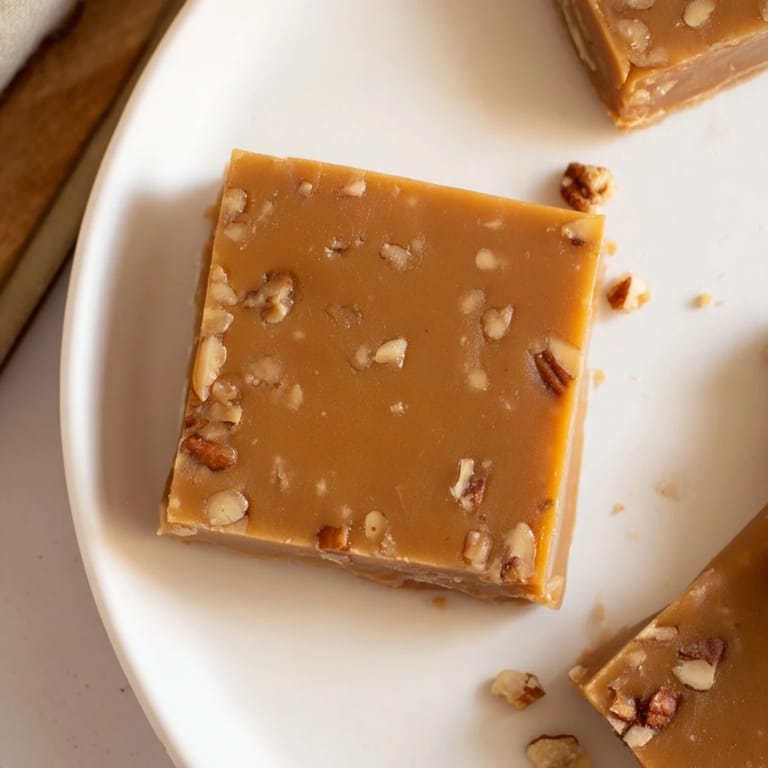
- Use the parchment overhang to lift the whole slab out, then cut into 1-inch squares with a sharp knife, wiping the blade between cuts so you get clean edges.
 Save
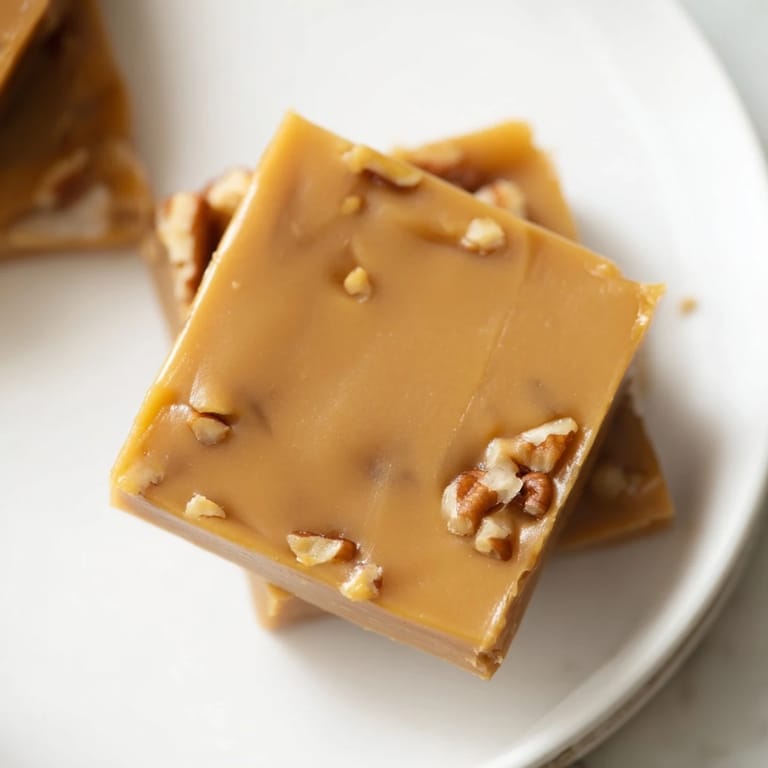
Save My sister texted me a photo of her kids holding squares of penuche fudge I'd sent, their faces covered in that warm brown-sugar stickiness, and I realized this recipe had become part of our family's language. Food does that sometimes—it stops being just something you eat and becomes how you say I was thinking of you.
The Science of Brown Sugar Magic
Brown sugar contains molasses, which gives penuche its distinctive deep caramel flavor and slight hygroscopic nature—it actually pulls moisture from the air. That's why the texture feels so creamy and dissolves on your tongue instead of sitting there like regular fudge. The soft-ball stage (238°F) is crucial because at that temperature, you have the perfect amount of water remaining to create a tender set rather than a rock-hard one. Understanding this transforms you from someone following instructions to someone who actually knows why each step matters.
Troubleshooting the Tricky Bits
If your fudge seized and became grainy while beating, you added the vanilla too early or went too fast—next time, let it cool those full 10 minutes and beat at a slower speed. If it never firmed up, your thermometer might be off by a few degrees, or you didn't beat it long enough; in either case, you've made an excellent fudge sauce for ice cream, so nothing's wasted. If it's hard as a rock, you cooked it past soft-ball stage—save it as a lesson and make another batch, because candy-making is forgiving if you keep notes.
Making It Your Own
Once you've made it once the traditional way, you'll start imagining variations. A pinch of cinnamon adds warmth; maple extract brings a subtle depth; a dash of bourbon makes it feel grown-up. Sea salt sprinkled on top before it fully sets creates a salted penuche that tastes like caramel meets pretzels. Some people press it into the pan with crushed pecans on top, and others swirl in a tablespoon of peanut butter for something almost entirely different. The beauty of penuche is that it's a canvas—once you trust the basic formula, you can paint with flavors.
- Toast your nuts in a dry skillet for two minutes before chopping for a deeper, roasted flavor that transforms the fudge.
- Store it in an airtight container with parchment between layers so pieces don't stick together in the humidity.
- It keeps for a week at room temperature, or up to three weeks in the refrigerator if you can resist eating it sooner.
 Save
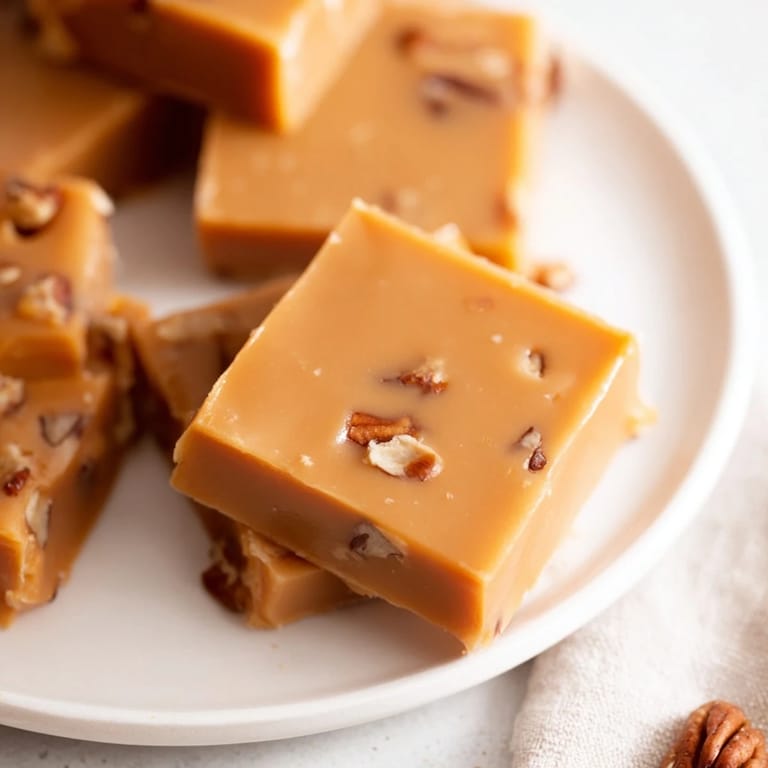
Save Penuche fudge is the kind of recipe that improves with repetition—each batch teaches you something your hands remember the next time. Make it, share it, and watch how something so simple can mean so much.
Questions & Answers
- → What is penuche fudge made from?
It primarily features light brown sugar, granulated sugar, milk, butter, and vanilla extract, producing a caramel-like flavor with a smooth texture.
- → How do I achieve the right texture?
Cooking the sugar mixture to 238°F (soft-ball stage) and beating it after cooling ensures the fudge sets with a creamy, melt-in-mouth consistency.
- → Can nuts be added?
Chopped pecans or walnuts can be folded in for added crunch and flavor, but can be omitted for a nut-free version.
- → How should the fudge be stored?
Keep it in an airtight container at room temperature for up to one week to preserve its softness and flavor.
- → Are there variations to enhance flavor?
Adding a pinch of cinnamon or a splash of maple extract can provide extra depth to the caramel-like taste.